Published
A long retirement and poorly timed losses can turn the same savings balance into very different outcomes. A falling stock market is easy to see. The financial risk of living longer than expected develops much more quietly.
Vanguard’s How America Retires 2026 places both risks at the center of retirement income planning. Investment returns influence how a portfolio grows or shrinks, while longevity determines how many years that portfolio must support.
For retirees, those questions belong in the same conversation.
Why a 30-Year Retirement Changes the Plan
Retiring at 66 and funding expenses through 86 means covering 20 years. Funding them through 96 requires another decade of income, healthcare expenses, home maintenance, and inflation adjustments.
Vanguard’s longevity illustration shows why that distinction matters. Its example begins with $1 million at age 66. Under the illustrated spending and market paths, the portfolio reaches zero around age 88 in poor conditions and age 91 in typical conditions.
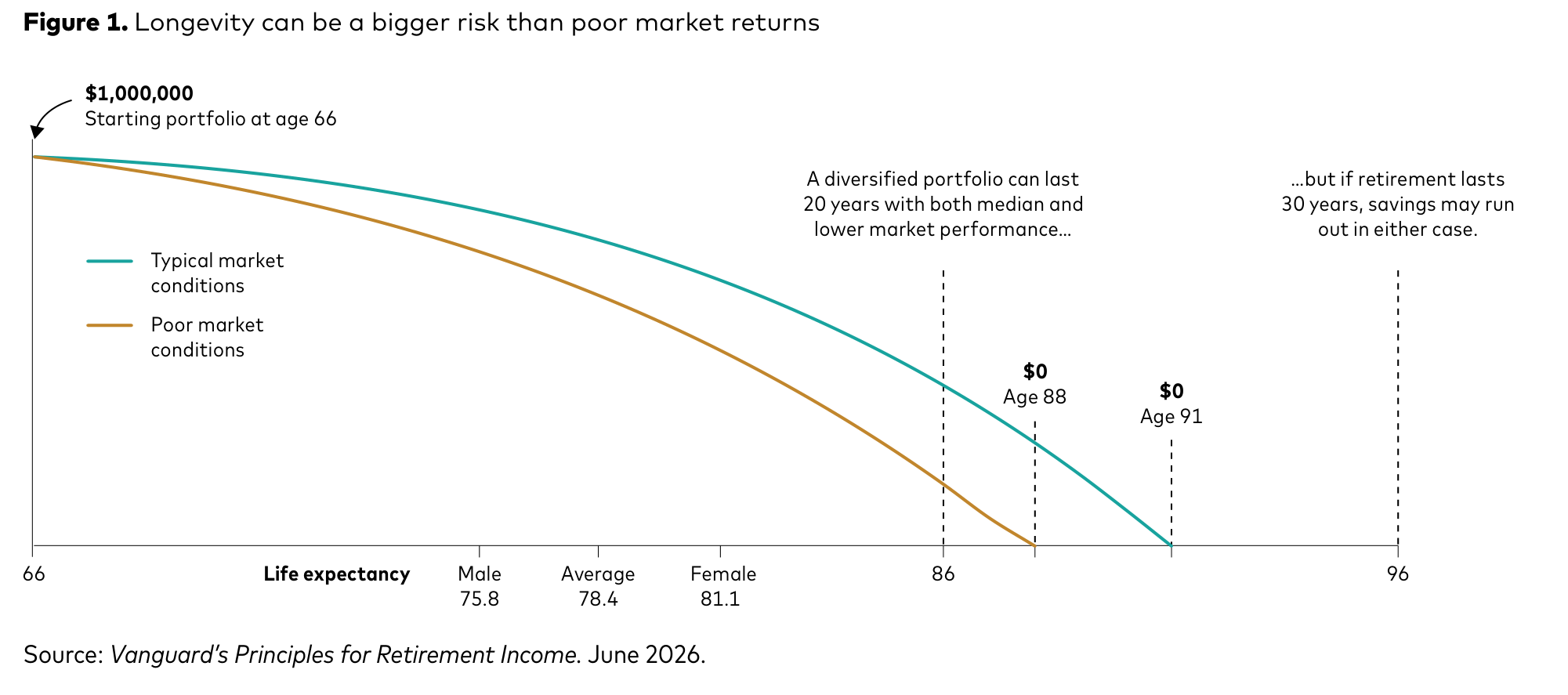
Source: Vanguard, How America Retires 2026, Figure 1, citing Vanguard’s Principles for Retirement Income, June 2026. This is an illustration, not a forecast for every $1 million portfolio. The figure does not provide all modeling assumptions. Its life-expectancy labels should not be interpreted as a personalized estimate of remaining lifespan at retirement.
The lesson is not that $1 million inevitably runs out. It is that a balance cannot be evaluated without considering spending and the period it must cover.
The Order of Returns Matters When Money Is Leaving
Vanguard also highlights sequence-of-returns risk. This is the danger that losses arrive early, when withdrawals are reducing the money available to participate in a recovery.
Consider two hypothetical portfolios starting with $1 million. Each has $40,000 withdrawn at the beginning of each year. Both experience the same four annual returns: a 20% loss and gains of 10%, 15%, and 20%. Only the order changes.
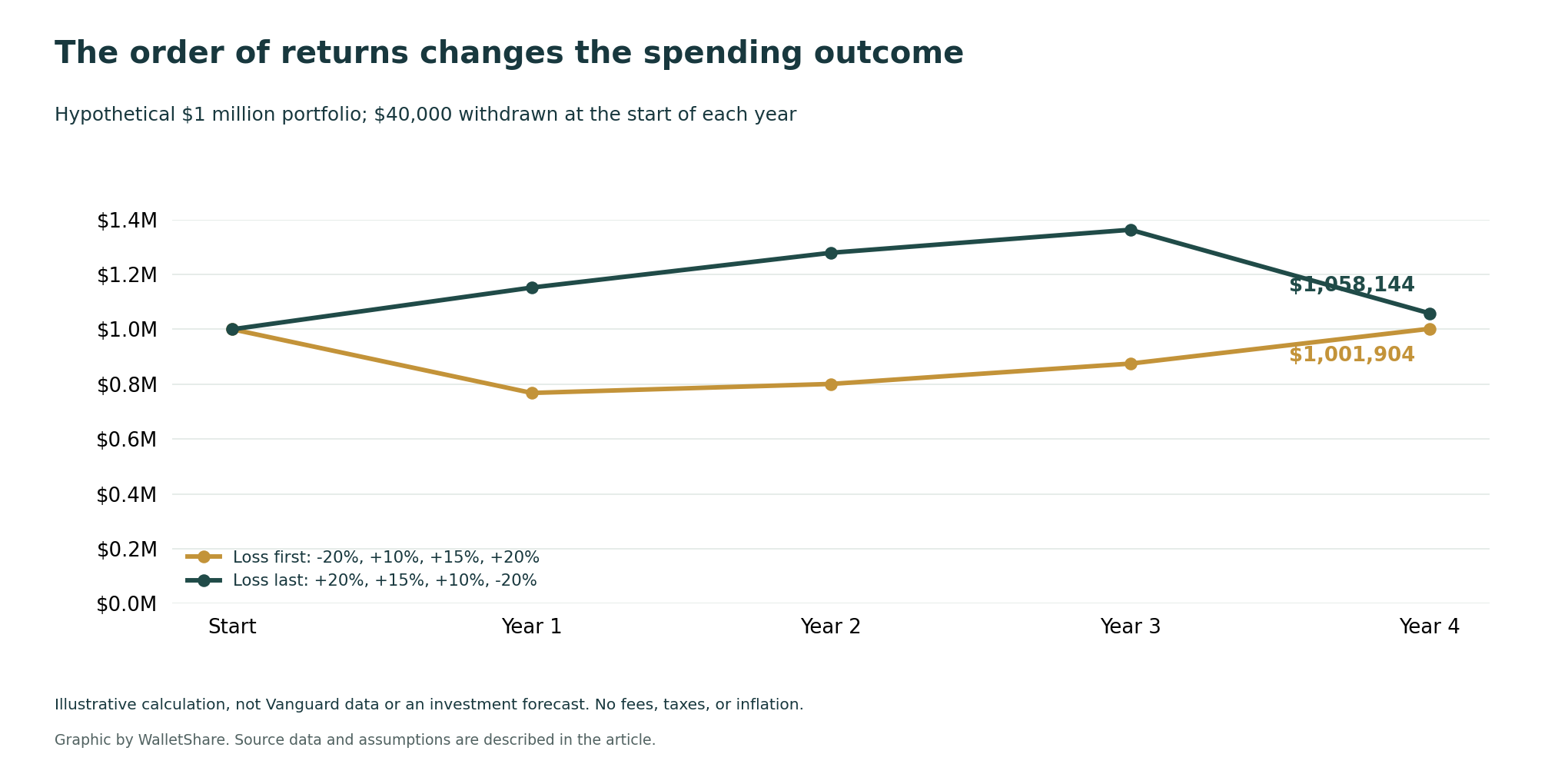
WalletShare calculation. These are invented return sequences for explanation, not Vanguard results or a market forecast. Withdrawals are fixed, and taxes, fees, and inflation are excluded.
The portfolio suffering the loss first finishes with approximately $1,001,904. The portfolio suffering the loss last finishes with approximately $1,058,144. The $56,240 difference arises despite identical compounded market returns before withdrawals.
Without withdrawals, rearranging those annual returns would not change the final balance. With withdrawals, the timing matters because different amounts remain invested each year.
Inflation Extends the Challenge
A long retirement also gives inflation more time to affect expenses. At a hypothetical 2.5% annual inflation rate, something costing $40,000 today would cost approximately $83,900 after 30 years.
Actual spending will not follow a smooth line. Travel may decline, medical costs may rise, and a major repair may arrive unexpectedly. Nevertheless, preserving purchasing power is different from simply preserving the same dollar withdrawal.
Managing the Risks Together
The report discusses several possible responses: maintaining a diversified portfolio, adjusting discretionary spending when necessary, coordinating Social Security with portfolio withdrawals, and considering whether dependable income adequately covers essential expenses.
Each involves tradeoffs. Holding more cash can provide near-term spending flexibility but reduce growth potential. Maintaining stock exposure can support a long horizon while increasing short-term volatility. Spending less after losses may protect savings but require meaningful lifestyle changes.
A useful planning question is therefore broader than whether a portfolio can survive a bad year. It is whether the household can adapt to a bad early market, higher expenses, and a retirement that lasts longer than expected.
Source: Vanguard, How America Retires 2026, printed pages 6–7 and 29–30. © 2026 The Vanguard Group, Inc. All rights reserved. This article explains planning concepts rather than prescribing a personal withdrawal strategy.